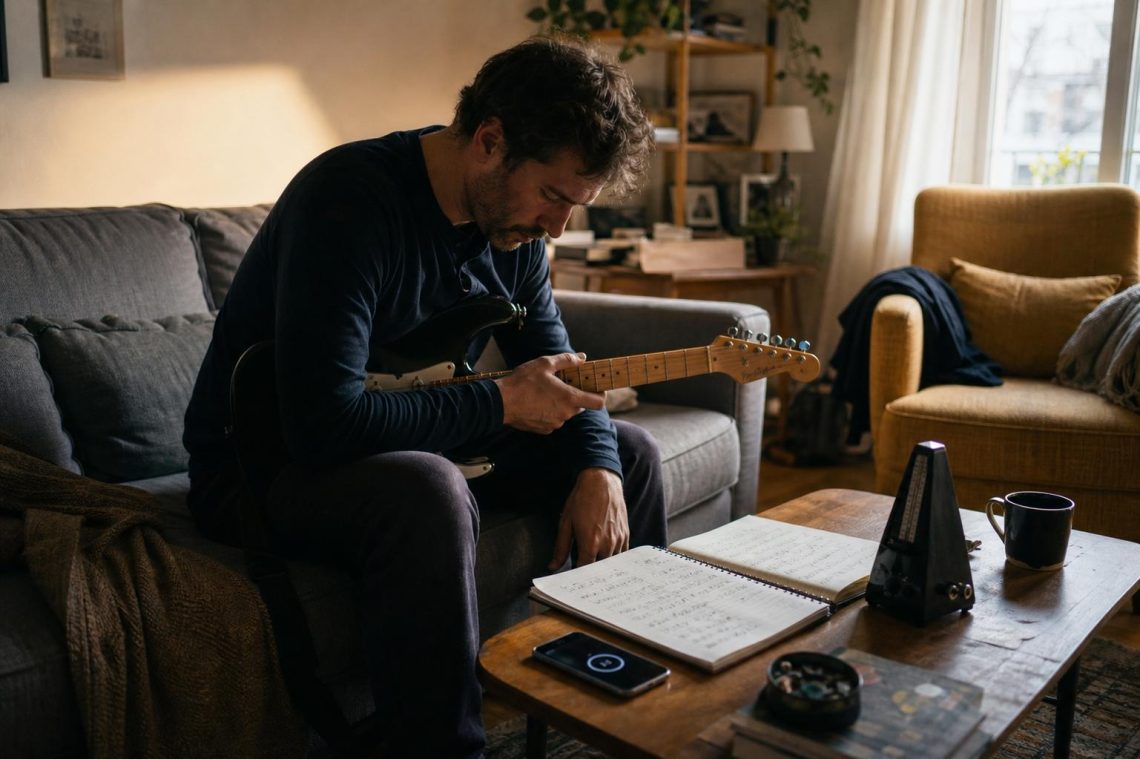
When Your Hobby Starts Feeling Like a Performance Review
You finish a run and immediately check your pace. You play guitar for an hour, but the only part you remember is the song you still cannot play cleanly. You come home from a game and spend the evening replaying your mistakes.
Nothing terrible happened. You did the activity you supposedly enjoy. Yet somehow, you feel as if you have just received disappointing feedback at work.
I have noticed that hobbies rarely become stressful all at once. The change is quieter than that. At first, you track progress because it makes the hobby more interesting. Then progress becomes the reason the activity counts. Eventually, every session starts answering a question you never meant to ask: Am I getting better fast enough?
That is usually the moment a hobby stops being play and starts becoming proof.
The Quiet Moment Play Turns Into Proof
Most people do not decide to make a hobby stressful. They simply become more invested.
You learn enough to recognize your mistakes. You discover people who are much better than you. You set a goal, buy better equipment, or start sharing your results. Each step seems harmless, and often it is. Improvement can be deeply satisfying.
The problem begins when the experience of doing the activity matters less than what the activity says about you.
A slow run is no longer just a slow run. It becomes evidence that you are losing fitness. A painting you dislike becomes evidence that you lack talent. Missing an easy shot becomes evidence that all your practice is not working.
Notice how quickly the mind turns one ordinary session into a larger verdict. You did not merely perform poorly today. You are now questioning your discipline, ability, or potential.
This is one reason people can become strangely irritable after doing something they claim to love. A partner may reasonably wonder why a Saturday morning hobby keeps ruining the rest of Saturday. From the outside, the person went cycling, played golf, or worked on a creative project. From the inside, they just sat through an evaluation of themselves.
The hobby has not necessarily changed. The question being asked of it has.
Why Tracking Progress Changes the Experience
There is nothing wrong with keeping score, recording times, counting repetitions, or comparing your recent work with older work. Feedback helps us improve.
But measurement does more than record an experience. It directs attention.
Once you begin measuring a hobby, you start noticing whatever can be counted. A runner watches pace rather than the neighborhood. A reader counts completed books rather than lingering over a difficult chapter. A musician works on the same impressive passage while neglecting the simple pleasure of playing familiar songs.
What gets measured slowly starts to feel like what matters.
Another pattern appears when people improve quickly at the beginning. Early progress creates an expectation that effort should keep producing visible results. When progress naturally becomes less obvious, an ordinary plateau can feel like failure. The person may respond by practicing harder, buying more equipment, or turning every casual session into another attempt to break through.
Ironically, the more urgently they chase the feeling that first attracted them to the hobby, the less likely they are to experience it.
Tracking also changes what counts as a good day. Without a score, a good day might mean you felt absorbed, laughed with someone, tried something new, or came home calmer. With a score, all those things can happen and the day can still feel unsuccessful.
That is the tradeoff. Measurement gives you clarity about performance, but it can make you less aware of experience.
The Difference Between Participating and Performing
A useful distinction is to ask whether you are participating in the activity or performing for an evaluator.
The evaluator does not have to be another person. It can be an app, a personal record, an online audience, or the voice in your head that keeps comparing today with your best day.
When you are participating, your attention is mostly inside the experience. You notice the sound, movement, challenge, company, or concentration the hobby requires. Mistakes are part of what is happening.
When you are performing, your attention keeps leaving the experience to observe you from the outside. How good do I look? Was that better than last time? Would this be worth sharing? Am I still the kind of person who is good at this?
That last question carries more weight than it seems. Adults often choose hobbies partly because the activity gives them an identity beyond work and family responsibilities. That can be healthy. But once being a runner, photographer, cook, or musician becomes important to your self image, a disappointing session can feel personally threatening.
You may also become less willing to be playful. Beginners try odd things because they have little reputation to protect. More experienced people sometimes avoid experimentation because being temporarily bad feels like moving backward. They repeat what they can already do well, then wonder why the hobby feels stale.
Participation allows you to be present. Performance asks you to produce evidence. Both have a place, but they do not create the same kind of afternoon.
How to Protect a Hobby From Becoming Another Job
I do not think the answer is to stop caring about improvement. For many people, challenge is part of the enjoyment. Removing every goal can make a hobby feel aimless rather than freeing.
A healthier approach is to stop asking one session to provide both play and proof.
Before you begin, decide what kind of session you are having. Some sessions can be practice. You focus on a weakness, record results, accept frustration, and try to improve. Other sessions can be participation. You do the activity without requiring it to demonstrate anything about your ability.
This distinction sounds small, but it changes how you interpret what happens. A difficult practice session may still be useful. A relaxed participation session does not become worthless because it produced no measurable improvement.
It also helps to delay evaluation. If you check every number, photograph, recording, or result immediately, judgment becomes the final moment of the activity. That is the feeling you carry home. Try letting some sessions end before you review them. Give yourself time to notice whether you actually enjoyed what you were doing.
Pay attention to how you describe the hobby afterward. If someone asks how it went, do you mention what happened or only how you performed? Saying that the weather was beautiful, the group was fun, or you finally understood part of a song is not avoiding standards. It is remembering that an experience can have value beyond ranking.
My practical recommendation is simple: make your next session an experience session on purpose. Do not lower your standards forever. Just spend one afternoon refusing to turn the activity into evidence.
When it is over, ask yourself one question: If nobody recorded this, praised it, or compared it with last time, was I still glad I did it?
Your answer will tell you more about the health of your hobby than another performance review ever could.
